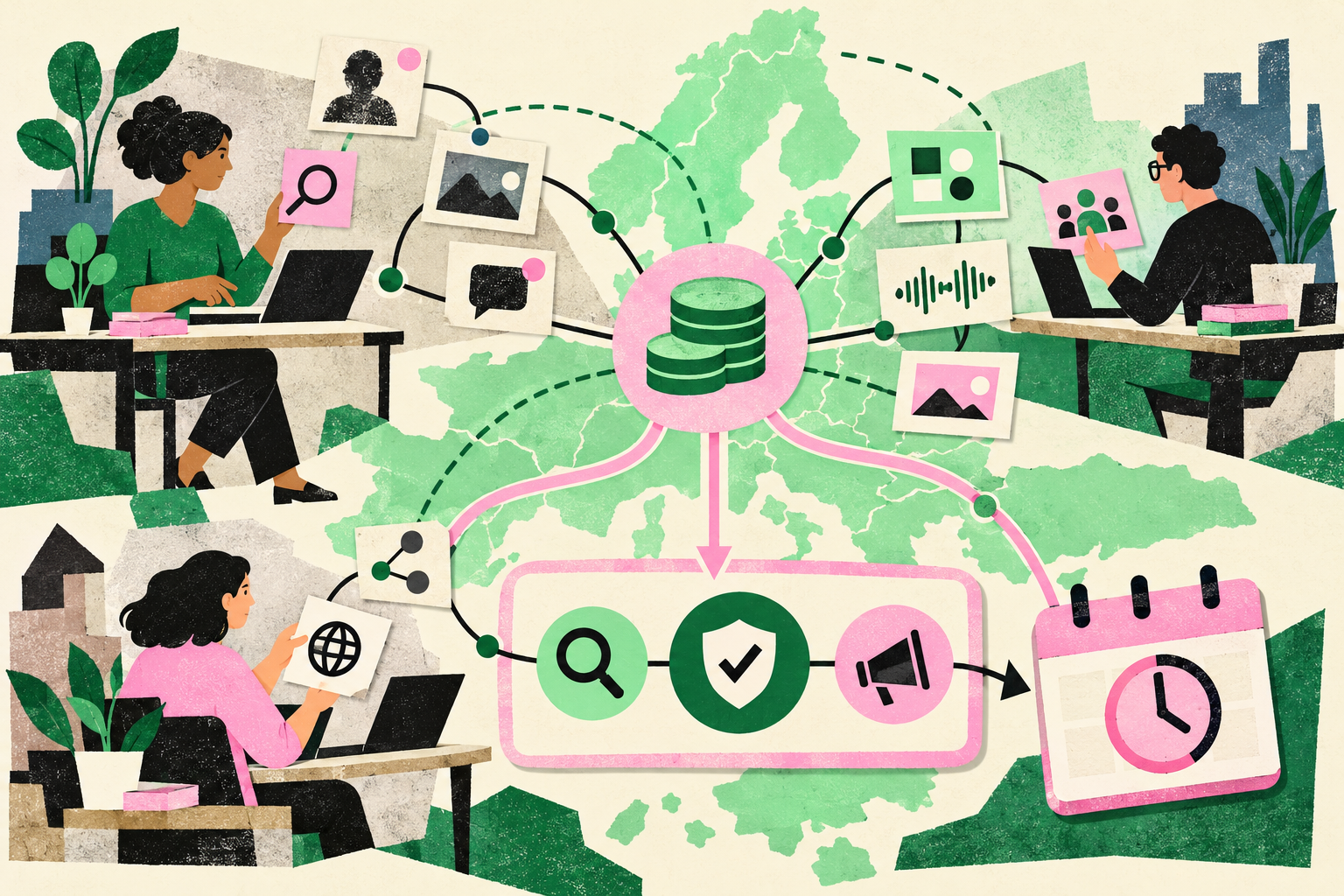
The European Commission opened a €3.5 million Creative Europe call for cross-border media-literacy projects on 22 October. Nonprofit organisations are explicitly eligible, but the opportunity is built for consortia rather than solo applicants: each proposal needs at least three entities from three countries participating in the Creative Europe programme. The practical first step is to test partnership, co-funding and delivery capacity before investing in a full bid.
1. Confirm that the consortium passes the country test
Map the legal entity and participating country for every proposed partner. The minimum is three entities from three different Creative Europe countries. Name a lead applicant, assign one accountable owner for each work package and record what each partner contributes beyond geographic coverage. Nonprofits can participate alongside media-literacy organisations, research and technology institutions, public bodies, education providers, news media or technology providers.
2. Build the budget around the 70% funding ceiling
The call offers up to €500,000 per project for a maximum duration of two years and funds no more than 70% of eligible costs. That means the partnership must cover the remaining share and any ineligible or overspent costs. Before writing activities, identify the source of match funding, partner cash flow, staff time and approval process. A €500,000 EU contribution would imply a total eligible project budget of at least about €714,286; treat that as planning arithmetic, not a promise that the maximum award will be granted.
3. Tie technology to a measurable literacy outcome
The Commission highlights challenges involving social media, influencers, AI-generated content, disinformation and foreign information manipulation. A proposal should therefore describe the audience problem first, then explain why a tool, platform, curriculum or verification workflow is needed. Define what participants should be able to recognise, assess or do after the intervention, how the consortium will measure that change and which risks could make the technology less accessible or trustworthy.
4. Separate evidence from the project hypothesis
List the sources that establish the need in each participating country and distinguish them from assumptions the project will test. Agree on common definitions, a baseline, outcome indicators and a method for comparing results across languages and settings. If the proposal uses AI-generated examples or automated detection, document human review, error handling, copyright and data-protection controls. The call identifies eligible themes; it does not prove that a particular intervention works.
5. Make cross-border reuse visible in the work plan
A credible European partnership should produce more than parallel local activities. Show which methods, training assets, evaluation results or technical components will be shared, translated, adapted and reused across countries. Assign responsibility for safeguarding, accessibility, procurement, data handling and dissemination. Include decision points for stopping or changing an approach if evaluation shows that it confuses audiences, excludes a group or amplifies harmful material.
Work backwards from 20 January
The application deadline is 20 January 2027. Use an internal go-or-no-go date to confirm eligibility and match funding, then schedule partner mandates, budget reconciliation, evidence review and final sign-off. Leave time to enter the application in the EU funding portal and resolve account or validation problems. The Commission page also links to the portal's partner search, national Creative Europe desks and an information session on 29 October.
What the announcement does not guarantee
The official pages establish the call terms and policy focus, not the competitiveness of a particular consortium or the effectiveness of its proposed method. The €3.5 million is the total call budget, not funding reserved for nonprofit applicants, and meeting the eligibility conditions does not ensure selection. Applicants should use the formal call documents and funding portal as the controlling source if details differ from a summary page.