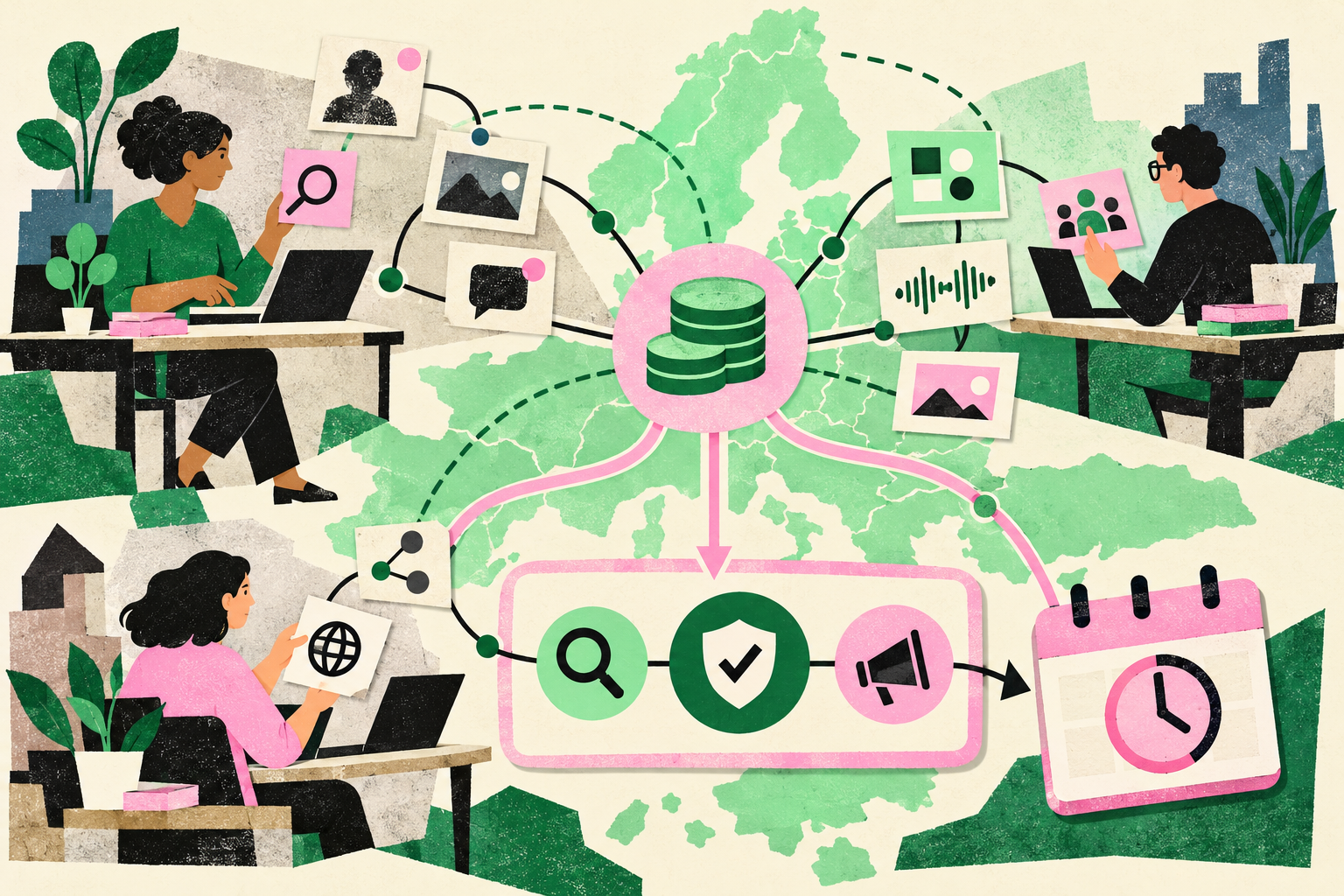
Blackbaud unveiled Lantern on 29 September as a language model designed for fundraising. The company says it is being developed with Databricks and post-trained on synthetic scenarios modelled on Blackbaud's Social Impact Signal Graph. The practical fact for buyers is the timetable: Lantern is expected to begin powering selected Raiser's Edge NXT and Agents for Good capabilities in 2027, with broader availability planned later. It is not yet a generally available product that an NGO can evaluate end to end.
1. Ask what will actually be available
Request the exact feature, product tier, market, release status and contract terms that would apply to your organisation. Separate access to a Lantern-powered capability from access to the underlying model. Ask whether the feature can be disabled, which existing workflows it changes and what happens when the vendor updates the model. Do not budget from a launch announcement alone.
2. Define evidence before a demonstration
Choose a bounded fundraising task and write down the current baseline: staff time, error rate, donor-response rate or another outcome the team already measures. Ask for evidence on the same task, including false positives, missed opportunities and performance across different donor groups. Blackbaud's announcement describes intended benefits but publishes no model card, benchmark, customer outcome data or independent evaluation for Lantern.
3. Trace every use of donor data
Map which donor and prospect fields enter the feature, where prompts and outputs are retained, which staff can see them and whether subprocessors receive them. Blackbaud states on its responsible-AI page that customer data is not used to train its AI models and remains under customer control. Buyers should still require the applicable AI terms, retention settings, deletion process and product-specific data flow in writing.
4. Keep people responsible for fundraising decisions
Specify which outputs are advisory, who reviews them and which actions always require approval. Test whether staff can see the reason for a recommendation, correct the underlying record and override the output without workarounds. Blackbaud says its AI approach uses human oversight, but the launch material does not document Lantern's product-level review controls. Verify those controls in the actual feature rather than treating a company principle as implementation evidence.
5. Pilot with a stop rule and an exit path
Use de-identified or low-risk data first, limit the pilot to a named team and set a review date. Decide in advance what level of inaccurate, biased or unexplained output stops the test. Require usable exports, deletion confirmation and a process for returning to the previous workflow. Include configuration, training, supervision and data-cleanup time in the cost, not only any licence fee.
What remains unknown
The announcement does not provide pricing, detailed availability by country, a technical model card, independent performance results or the full product controls that will accompany each Lantern-powered capability. Those gaps make this a planning and due-diligence story, not evidence that the model improves fundraising. Reassess the questions when a specific capability reaches documented availability.